
Education
At 25, Nigerian-Born Researcher Dr. Faisal Hamman Emerges as Global Voice on Trustworthy AI
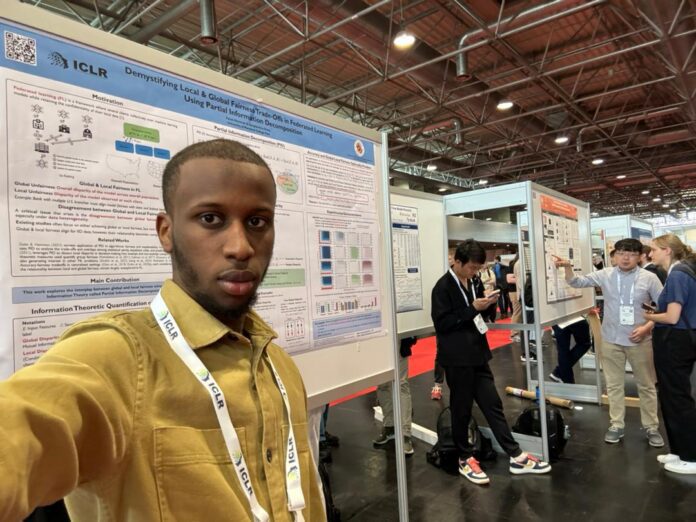
At just 25, Faisal Adamu Hamman has joined a select group of young scientists shaping the future of artificial intelligence, tackling one of the most pressing questions in modern technology: Can AI be trusted?
Fresh from earning a doctorate in Electrical and Computer Engineering from the University of Maryland, the Adamawa-born researcher is gaining international recognition for his work on what experts describe as “trustworthy and reliable machine learning.”
But long before American research laboratories and global AI conferences, Hamman’s story began in Abuja, Nigeria’s Federal Capital Territory, where he was raised by his parents, Adamu Hamman and Aisha Adamu Hamman, both engineers.
“We noticed his special gift early,” his parents said in an interview. “He consistently won awards in Mathematics, Further Mathematics and Physics. By senior secondary school, his excellence was undeniable.”
After graduating in 2016 with nine distinctions — seven A1s and two B2s — in the West African Examinations Council School Certificate examination, his family made the pivotal decision to send him to Turkey for university studies, seeking an environment that would further challenge and refine his abilities.
In Istanbul, Hamman graduated summa cum laude in Electrical and Electronics Engineering, emerging as overall best graduating student with a near-perfect GPA. He later moved to the United States for graduate studies at the University of Maryland, one of America’s leading engineering institutions.
For Hamman, artificial intelligence was a natural fit.
“I have always enjoyed solving complex problems through mathematics and engineering,” he said, describing AI as a powerful blend of theory, data and computation.
As AI systems increasingly power medical diagnoses, financial markets, loan approvals and everyday digital tools, concerns about reliability, bias and unpredictability have intensified. Hamman’s doctoral research addresses these risks by developing mathematical and computational tools to ensure AI systems remain accurate, transparent and capable of signalling uncertainty.
“Explainability is no longer optional,” he said. “As AI becomes embedded in daily life, it is essential for safety, accountability and public trust.”
During his PhD, he presented his work at some of the world’s most competitive AI conferences, including NeurIPS, ICML, and ICLR, as well as publishing at ACM FAccT and IEEE ISIT. Sharing platforms with researchers from leading AI laboratories such as OpenAI, Google and Meta marked a defining milestone in his career.
His academic achievements earned him several prestigious honours at Maryland, including the Distinguished Dissertation Fellowship, the Ann G. Wylie Dissertation Fellowship and the Clark School Doctoral Dean’s Research Award — distinctions reserved for top doctoral graduates. He also received awards recognising excellence in teaching.
For his parents, the moment he earned his PhD at 25 was deeply emotional.
“It was a moment of pride and gratitude,” they said. “We remembered the sacrifices and years of effort. It was more than a degree.”
Back home in Gombi, Adamawa State, his achievement carries symbolic weight. According to his father, it demonstrates that background does not limit global success and offers hope to young Nigerians aspiring to compete on the world stage.
As Africa’s digital transformation accelerates and AI systems increasingly influence banking, healthcare and public services, researchers like Hamman represent a growing generation of African scholars contributing not just as users of imported technologies, but as architects shaping how they are designed, tested and governed.
Now exploring research and industry opportunities, Hamman remains focused on critical questions: How can reliability be measured in self-learning systems? How can bias be prevented? And how can AI systems recognise when they are uncertain?
For the young researcher from Adamawa, the journey is only beginning — but his work already signals a powerful promise: that the future of artificial intelligence can be not only innovative, but principled, with African minds helping to define it.
See also:
Education Secretary Applauds One-Day Governor During her Visit to Imota LCDA
Canada Opens Applications for Fully Funded 2026 Scholarships for International Students
60% Score Five Credits as NABTEB Releases 2025 Nov/Dec Results
Over 80% of Candidates Score Five Credits as NECO Releases 2025 SSCE External Results
Ikeja Schools on Lockdown as Police Move In After WhatsApp Threats