

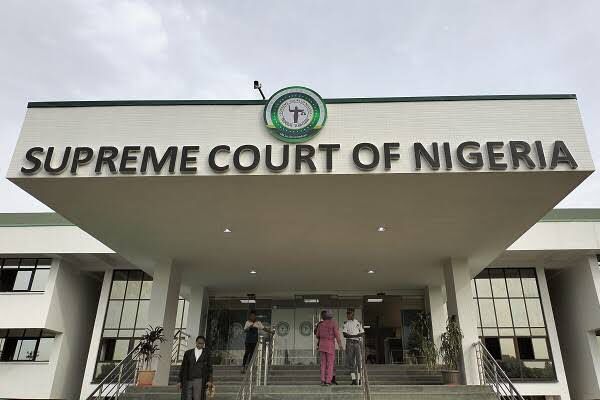
The Supreme Court on Monday upheld the constitutional power of the President to declare a state of emergency in any state to avert a breakdown of law and order or a drift into anarchy.
The judgment was arrived at by a majority of six to one. The court affirmed the powers vested in the President to announce a state of emergency under the Constitution. Additionally, it ruled that in a state of emergency, the President can remove elected state officers for a short time.
Delivering the lead judgment, Justice Mohammed Idris stated:
“The powers under section 305 of the 1999 Constitutional framework are not narrowly defined, but are broad, leaving room for the President to do whatever it takes to regain normalcy in a situation where a state of emergency is placed in abeyance.”
This meant that the 1999 Constitutional framework did not define how such powers were exactly supposed to be exercised by President Jonathan.
The judgment followed a lawsuit initiated by states ruled by the Peoples Democratic Party in opposition to President Bola Tinubu over his declaration of a state of emergency in Rivers State, when state officers were suspended for six months. The Supreme Court of Nigeria had reserved judgment in this case in October.
The plaintiffs in this case were the Attorneys General in PDP-controlled states, while the defendants were the Federal Government and the National Assembly. The case was brought before court by the Attorneys General of the states of Adamawa, Enugu, Osun, Oyo, Bauchi, Akwa Ibom, Plateau, Delta, Taraba, Zamfara, and Bayelsa.
The case was marked SC CV 329 2025, and there were eight grounds on which the case was based. The plaintiffs sought a declaration from the court on the query of whether it is within the powers of the President to suspend a democratically elected state government and whether the manner in which a state of emergency can be proclaimed in Rivers State complies with the 1999 Constitution. Other reliefs were sought in a declaration on a query of whether it is within the powers of the President to suspend, challenge, or influence in any manner whatever, the offices of a Governor, a Deputy Governor, or a State House of Assembly, and substitute them with an ‘unelected Sole Administrator’ in a proclamation of a state of emergency.
The suit was struck out for want of jurisdiction by Justice Idris, but he went on to examine the merits of the case before striking it out.
However, this judgment was partly overruled by the dissenting opinion of Judge Obande Ogbuinya. Although he concurred with the majority judgment that the President can proclaim a state of emergency, he disagreed with the suspension of elected state officers such as governors, deputy governors, and state legislators.
At an earlier stage in the case, Judge Idris affirmed the preliminary objections which were filed by both the Attorney General of the Federation and the National Assembly in rejecting the claim that a cause of action had been established which could invoke the original jurisdiction of the Supreme Court. In light of this, the court, in arriving at a majority judgment, stated that the plaintiffs failed to prove the existence of a justiciable dispute in a case worthy of the application of the court’s original jurisdiction.