
Headlines
Senate Passes State Police Bill, Paving Way for Historic Security Reform
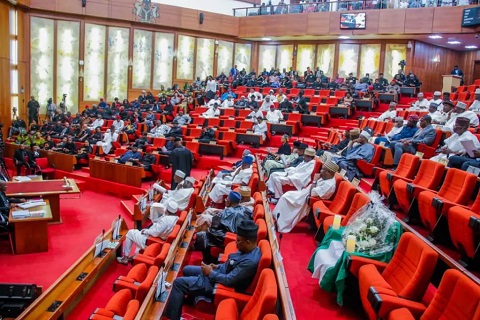
The Senate on Wednesday approved the long-awaited State Police Bill, marking a significant milestone in Nigeria’s constitutional reform process and bringing the country closer to adopting a decentralised policing system aimed at addressing its growing security challenges.
The bill, titled “A Bill for an Act to Alter the Constitution of the Federal Republic of Nigeria, 1999 to Provide for State Police and Related Matters, 2026,” was passed after lawmakers considered and adopted its provisions clause by clause during the Committee of the Whole.
Its passage followed the submission of a report by the Senate Committee on the Review of the 1999 Constitution, chaired by the Deputy Senate President, Senator Jibrin Barau.
The proposed constitutional amendment seeks to replace Nigeria’s long-standing centralised policing structure with a federal policing model that empowers state governments to establish and operate their own police services while maintaining nationally prescribed standards and constitutional safeguards.
According to the committee’s report, the legislation represents one of the most far-reaching institutional reforms currently under consideration by the National Assembly.
The report stated that while states would have the authority to establish their own police organisations, the proposed framework also provides mechanisms for federal oversight under clearly defined exceptional circumstances to ensure national security and constitutional compliance.
The committee described the bill as a response to the country’s evolving security realities, noting that reforming Nigeria’s policing architecture had become a matter of urgent national importance.
Presenting the lead debate on the bill, Senate Leader Opeyemi Bamidele explained that the legislation was transmitted to the National Assembly by President Bola Tinubu as an Executive Bill.
He described the proposal as a landmark constitutional reform designed to modernise Nigeria’s internal security framework and improve the effectiveness of law enforcement across the federation.
Bamidele noted that Nigeria’s size, diverse ethnic composition, geographical complexity and varying security situations require a policing system that is more responsive to local realities than the current centralised structure.
According to him, emerging threats such as terrorism, banditry, kidnapping, communal conflicts, farmer-herder clashes, cybercrime and organised criminal activities have exposed the limitations of the existing policing arrangement.
He argued that allowing states to establish their own police services would improve intelligence gathering, enhance rapid response capabilities and strengthen collaboration between local communities and law enforcement agencies.
The debate over state police has remained one of the most contentious constitutional issues in Nigeria for more than two decades. While supporters argue that decentralised policing is essential to tackling insecurity, critics have expressed concerns that state governments could misuse police formations for political purposes or to intimidate opponents.
To address such concerns, the proposed amendment incorporates constitutional safeguards, operational standards and provisions for federal intervention under exceptional circumstances where national security may be threatened.
Following the passage of the bill, Senate President Godswill Akpabio expressed optimism that the reform would significantly improve security across the country.
He said he hoped the establishment of state police would contribute to reducing incidents of kidnapping, banditry and terrorism while restoring public confidence in Nigeria’s security institutions.
“It is my prayer that Nigerians will become safer and that the challenges of kidnapping, banditry and terrorism will not only be minimised but reduced to the barest minimum. I am confident that Nigeria shall overcome terrorism and banditry,” Akpabio said.
Although the Senate’s approval represents a major legislative breakthrough, the constitutional amendment process is not yet complete. The bill must also secure the required approval of the House of Representatives and be endorsed by at least two-thirds of the country’s 36 State Houses of Assembly before it can be transmitted to the President for assent.
If eventually enacted into law, the legislation would fundamentally reshape Nigeria’s policing system, ending decades of exclusive federal control over law enforcement and ushering in one of the most significant constitutional changes since the country’s return to democratic governance in 1999.