
Headlines
Shettima Reveals Tinubu Rejected ‘Charm’ Allegation Over Campaign Attire
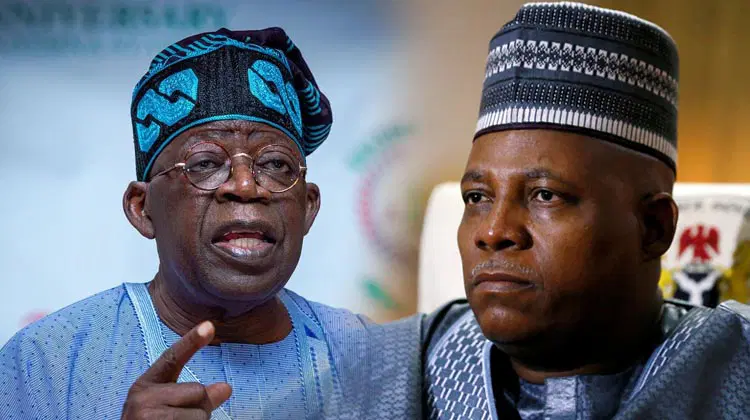
Vice President Kashim Shettima has revealed that shortly after President Bola Tinubu assumed office in 2023, some individuals from Borno State allegedly warned the President against wearing traditional outfits given to him by Shettima during the election campaign, claiming the garments had been spiritually manipulated to control him.
According to the Vice President, Tinubu dismissed the allegation outright and intentionally continued wearing the attire for an entire week to demonstrate his rejection of what he described as baseless suspicion.
Shettima disclosed the incident on Tuesday while speaking at the public presentation of former Head of State Yakubu Gowon’s autobiography, My Life of Duty and Allegiance, held in Abuja.
The Vice President represented Tinubu at the event and used the story to illustrate what he described as the growing culture of distrust and suspicion in Nigerian society.
According to Shettima, the visitors had approached Tinubu barely three months after his inauguration and urged him to stop wearing traditional attire provided by him during the 2023 presidential campaign.
They allegedly claimed the clothes had been “charmed” and could lead to the President’s death.
Rather than entertain the allegation, Shettima said Tinubu openly rejected the narrative and responded by deliberately appearing publicly in the outfits for several days.
The Vice President said the President viewed the allegation as irrational and divisive.
Shettima contrasted the episode with stories from earlier generations of Nigerian leaders, which he said reflected stronger bonds of trust across ethnic and regional lines.
Referencing remarks made earlier by the Muhammadu Sa’ad Abubakar during the book presentation, Shettima recalled how the Sultan narrated that his family regularly sent gallons of fura to Gowon during his time as military Head of State at Dodan Barracks in Lagos.
According to Shettima, Gowon accepted the gesture without suspicion, reflecting what he described as a period when trust among Nigerians was stronger.
The Vice President lamented that such openness and confidence had gradually diminished in modern political and social interactions.
Political analysts say Shettima’s remarks highlight the influence of rumours, conspiracy theories and ethnic mistrust within Nigeria’s political environment, especially during periods of intense political competition.
Tinubu and Shettima emerged victorious in the 2023 presidential election on the platform of the All Progressives Congress, forming the first Muslim-Muslim presidential ticket in Nigeria’s recent democratic history.
Their candidacy generated heated national debates at the time, particularly over concerns about religious balance and political representation.
Observers say the Vice President’s comments also reflect ongoing efforts by the administration to project unity and counter narratives capable of deepening political or ethnic divisions.
The autobiography launch attracted prominent political leaders, diplomats, traditional rulers and former public officials, many of whom paid tribute to Gowon’s role in Nigeria’s history and national unity.
Gowon, who ruled Nigeria from 1966 to 1975, remains one of the country’s most influential former military leaders, particularly for his role during and after the Nigerian Civil War.